
Chemical and Process Engineering Department
THE DEPARTMENT OF CHEMICAL & PROCESS ENGINEERING
CoD's Message

Dr. Anthony Muthui Muliwa |
Message from the Chairman
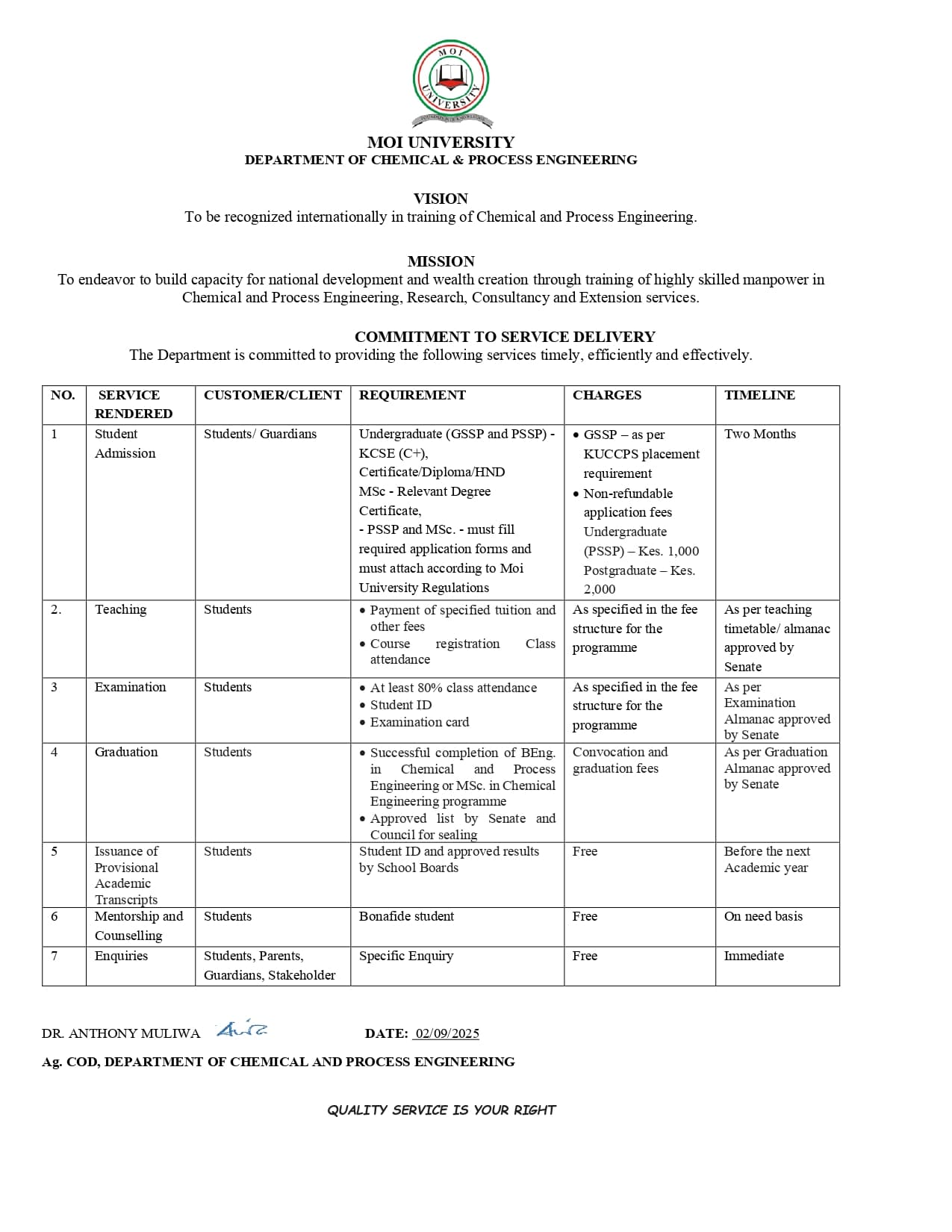
It is with great pleasure that I welcome you to the Department of Chemical and Process Engineering, Moi University. The Vision of the Department is “To be recognized internationally in training of Chemical and Process and Engineering” and the Mission of the department is “To endeavor to build capacity for national development and wealth creation through training of highly skilled manpower in Chemical and Process Engineering, Research, Consultancy and Extension services”.
The department was established in 1991 to offer Bachelor of Technology (BTech.) in Chemical and Process Engineering. However, due to rapidly changing trends in the academic and industry environments as well as the necessity to provide practical solutions to the ever changing societal challenges and emerging global issues, the programme was later revised in 2007, and now offers a course leading to the award of Bachelor of Engineering (BEng.) in Chemical and Process Engineering. The programme is offered on full-time mode for a period of 5 years. The programme is fully accredited by the Commission for University Education (CUE) and is recognized and regulated by the Engineers Board of Kenya (EBK). Graduates of this programme are well equipped to adopt innovative approaches to resource processing, energy management and technological application in complex, ill-defined problem-solving professional contexts.
What is a Chemical and Process Engineering?
Chemical and Process Engineering is a branch of engineering that deals with research, design, development, operation, management and supervision of large-scale industrial processes involved in the commercial production of products of daily life and other necessities. Thus, Chemical and Process Engineers conceive and design processes to produce, transform and transport materials – beginning with laboratory experiments followed by full-scale implementation of the technology. Chemical and process engineering is not about chemicals only or chemistry as it is perceived by many people. The addition of the title engineer completely distinguishes a chemical engineer from industrial or analytical chemists. Chemical and Process engineering differs from chemistry mainly in its focus on large scales or commercial. To do these jobs, Chemical and Process Engineers must have a complete and quantitative understanding of both the engineering and scientific principles underlying these technological processes. Thus, chemical Engineers are well grounded on engineering design principles, modelling and simulations, control systems and optimizations, economics, environment, energy, materials, among others. Prospective chemical engineering degree candidates ought to have a good understanding of mathematics, chemistry, physics, biology and economics. Chemical and Process engineers’ expertise spans a wide range of sectors, including manufacturing, petroleum and its derivatives, food and beverages, pharmaceuticals/drugs, water treatment, biotechnology, microelectronics, plastics and synthetic materials, agriculture, mining, managerial, academia/ research, consultancy, to name but a few.
Teaching and Learning
The department has adopted the Outcome based education (OBE) strategy in teaching and learning as per the Washington Accord Standards. Teaching and learning involves a mix of innovative approaches including, theoretical lectures and laboratory experiments which enhances leaners’ education by applying hands-on theoretical concepts. Also, learners undertake experiential learning via internal workshop practice for a period of 12 weeks, two external industrial attachments, each lasting 8-12 weeks each, and industry site tours/visits to appreciate industrial operations. In addition, during the fourth and fifth year of study, learners work on both individual and group projects and are allowed to flexibly select elective courses in more specialized areas. Teaching and learning is supported by the use of prominent modelling and simulation soft wares, such as ChemCAD and Aspen Plus. Learners are also exposed to spectrophotometric analytical equipment.
Admission Requirements
Entry requirements for our BEng Chemical and Process Engineering degree are as follows:
- Minimum mean grade of C+ (Plus) at KCSE and in addition the candidate must score a minimum of a C+ (plus) in each of the cluster subjects.
- Mathematics
- Physics
- Chemistry
- Either English/Kiswahili
- Applicants holding a three year KNEC Diploma in Engineering with a Pass, Credit or Distinction and a Minimum grade of C (PLAIN) in Mathematics, Physics, Chemistry, English and either Biology, Geography or any Group V subjects are eligible for admission to year 1 of study.
- Students with KNEC diploma in Engineering are eligible to apply for credit exceptions as per Moi University Policy
Career in Chemical and Process Engineering
The top destination of our graduates includes:
- Process Industries: pharmaceuticals, fine and heavy chemicals, agro-chemicals
- Power generation: gas and oil extraction, oil refining and nuclear energy, renewable energy
- Food and drink
- Plastic, metals, fibre
- Engineering consultancy and contracting firms
- Government and non-government organization
- Academia: Teaching and Research
- Service industry: Business, finance, management, IT etc.
Vision, Mission & Objectives
Vision
To be recognized internationally as a center of excellence in training of Chemical and Process Engineering.
Mission
To endeavour to build capacity for national development and wealth creation through training of highly skilled manpower in Chemical and Process Engineering, Research, Consultancy and Extension services.
Programme Educational Objectives (PEOs)
The PEOs outline the expected accomplishments of graduates after three (3) to five (5) years of graduation. There are four (4) PEOs for the Bachelor of Engineering in Chemical and Process Engineering Outcome Based Education (OBE) aligned programme, formulated based on the Moi University’s Vision, Mission, Educational goal and considering the requirements and interests of the employers and other stakeholders. They include:
PEO1: Graduates that are knowledgeable, competent and employable, capable of pursuing a successful career in Chemical and Process Engineering and allied industries
PEO2: Graduates that are proficient in applying the principles of engineering to design, develop, improve and maintain industrial processes to meet specified needs with consideration of process efficiency, public health, safety, and welfare.
PEO3: Graduates that are innovative, critical thinkers and problem solvers who strive to continuously align their activities for the betterment of the society.
PEO4: Graduates that exhibit entrepreneurial, leadership and high professional skills and attitudes while committed to ethics, professional integrity, sustainable development and lifelong learning
Programme Outcomes (POs)
The program outcomes specify the accomplishments, abilities, and information that students should have by the time they graduate. These are connected to the knowledge, abilities, and behaviors that students have acquired during the curriculum. The eleven (11) POs for the Bachelor of Chemical and Process Engineering POs are directly adapted from the International Engineering Alliance (IEA) general Graduate Attributes to guarantee alignment and conformance with WA criteria. They include:
PO1 - Engineering Knowledge: Apply knowledge of mathematics, natural science, computing and engineering fundamentals, and an engineering specialization as specified in WK1 to WK4 respectively to develop solutions to complex engineering problems.
PO2 - Problem Analysis: Identify, formulate, research literature and analyze complex engineering problems reaching substantiated conclusions using first principles of mathematics, natural sciences and engineering sciences with holistic considerations for sustainable development* (WK1 to WK4)
PO3 - Design/development of solutions: Design creative solutions for complex engineering problems and design systems, components or processes to meet identified needs with appropriate consideration for public health and safety, whole-life cost, net zero carbon as well as resource, cultural, societal, and environmental considerations as required (WK5)
PO4 - Investigation: Conduct investigations of complex engineering problems using research methods including research based knowledge, design of experiments, analysis and interpretation of data, and synthesis of information to provide valid conclusions (WK8)
PO5 - Tool Usage: Create, select and apply, and recognize limitations of appropriate techniques, resources, and modern engineering and IT tools, including prediction and modelling, to complex engineering problems (WK2 and WK6)
PO6 - The Engineer and the World: When solving complex engineering problems, analyze and evaluate sustainable development impacts to: society, the economy, sustainability, health and safety, legal frameworks, and the environment (WK1, WK5, and WK7)
PO7 - Ethics: Apply ethical principles and commit to professional ethics and norms of engineering practice and adhere to relevant national and international laws. Demonstrate an understanding of the need for diversity and inclusion (WK9)
PO8 - Individual and Collaborative Team work: Function effectively as an individual, and as a member or leader in diverse and inclusive teams and in multi-disciplinary, face-to-face, remote and distributed settings (WK9)
PO9 - Communication: Communicate effectively and inclusively on complex engineering activities with the engineering community and with society at large, such as being able to comprehend and write effective reports and design documentation, make effective presentations, taking into account cultural, language, and learning differences.
PO10 - Project Management and Finance: Apply knowledge and understanding of engineering management principles and economic decision-making and apply these to one’s own work, as a member and leader in a team, and to manage projects and in multidisciplinary environments.
PO11 - Lifelong learning: Recognize the need for, and have the preparation and ability for i) independent and life-long learning ii) adaptability to new and emerging technologies and iii) critical thinking in the broadest context of technological change (WK8)
Staff list
The Department is served by highly qualified, skilled, committed and dedicated team comprising the academic (Professors, Senior Lecturers, Lecturers and Tutorial Fellows), technical (Chief Technician, Technicians and Lab assistants) and support staff with diverse academic backgrounds. Approximately 60% of the academic staff are PhD holders with the rest having Master’s qualifications. The staff are a mix of specialists in areas such as reactor engineering, heat and mass transfer, plant design, energy, environment, water and wastewater, process simulation and optimization, process control, separation processes and fluid mechanics, among others. There are four Professors who are professionally registered as practicing engineers (PEs) while all other academic staff are registered with the Engineers Board of Kenya (EBK) and are also affiliated to the Institution of Engineers of Kenya (IEK) and Kenya Institute of Chemical Engineers (KICHE). Moreover, majority of staff have previously worked with various industries and possess relevant experience that makes them deliver teaching and learning seamlessly.
Academic Staff
1. Professor (Eng.) Henry Kirimi Kiriamiti
2. Professor (Eng.) Milton M’Arimi
3. Professor Saul Namango Sitati
4. Dr. Anthony Muthui Muliwa
5. Dr. Moses NyotoNglo Arowo
6. Dr. Cleophas Mecha Achisa
7. Dr. Wiseman Ngigi Tumbo
8. Dr. Cyprian Murutu Simiyu
9. Mr. Simon Otieno Osembo
10. Mr. Samuel S. Chemjor
11. Ms. Florence Ajiambo
12. Mr. Abraham Kibichii Chirchir
13. Mr. Daudi Masinde
14. Ms. Zeddy Mibei
Former Academic Staff
1. Professor Anil Kumar
2. Mr. Francis Maina Kagara
3. Dr. David Mutua Menzwa
4. Dr. Erick Thomas Odhiambo
5. Mr. Francis Munialo Opar
Technical Staff
1. Mr. William K. Chepkwony – Ag. Chief Technician
2. Mr. Alex K. Koech – Technician
3. Mr. Vincent K. Bitok – Laboratory Assistant
4. Mr. Paul Kipkemboi Lagat – Laboratory Attendant
Administrative Staff
1. Ms. Esther Kessio - Secretary
2. Ms. Jennifer Koech - Messenger
Research
Research
Our staff and students are actively engaged in research in areas such as water and wastewater, renewable energy, reactor engineering, process simulation and optimization. The department also won a NRF Grant on Treatment of Water to Potable standards for a period of 3 years The department also competitively received a grant in form of laboratory equipment worth millions of monies through Seeding Lab, USA and commissioning is ongoing. Additionally, our departmental staff continue to produce scientific outputs in form of publications in reputable journals as evidenced in respective google scholar accounts.
Integrated Design Projects and Experimental Research Projects
The final year students get involved in designing a complete chemical plant or process combining principles of process design, economics, safety, and environmental impact. The design project serves as a capstone experience, allowing students to apply and integrate the knowledge and skills acquired throughout their undergraduate training in the Chemical and Process Engineering. As a team, students work together to develop a
viable solution to a real-world design challenge. Furthermore, undertaking an experimental project in the final year of Chemical Engineering study is a critical component of the undergraduate training. It enables students to apply and integrate the theoretical principles acquired throughout the programme in a practical, research-oriented setting. Through the design and execution of experiments, students develop essential laboratory competencies, analytical and problem-solving skills, and an understanding of scientific research methods. The project further enhances students’
abilities in data interpretation, technical reporting, and professional communication. In addition, it provides exposure to project planning, safety practices, teamwork, and innovation - key attributes expected of engineering graduates. Overall, the final-year experimental project serves as a capstone experience that prepares students for professional practice, industry engagement, and postgraduate research.
2025 Design Projects
- Integrated design of furfural production plant using sugarcane bagasse and corn cobs as feedstock
- Industrial-based extraction of pyrethrin from pyrethrum flowers
- Fractionation and production of monoglycerides from palm oil
- Production of methanol from syngas
- Design of an organic waste biorefinery to produce biofuels, biofertilizer and biochemicals
- Compressed biogas production via anaerobic digestion of agricultural and municipal organic waste
- Plant design for the production of bio-plastics from palm oil wastes.
- Green hydrogen production using alkaline electrolysis
- Design of a green hydrogen production plant from biogas with integrated carbon capture
- Production of bio-lubricant from vegetable oils (synthetic esters)
- Design and production of syngas from coconut shells
- Production of sustainable paper from pineapple peel fibres
- The production of stearine from sunflower oil
2025 Experimental Projects
1. Production of Fatty Acid Methyl Ester (FAME) from used cooking oil
2. Recovery and Recycle of aluminium from raw water treatment sludge
3. Application of Solar photocatalytic TiO 2 doped with Fe 2 O 3 in water disinfection
4. Biodiesel Production from date seed oil utilizing calcium oxide derived from waste egg shells
5. Production of sodium silicate from silica dessicants
6. Solar water disinfection using co-doped TiO 2 -ZnO-Fe 2 O 3 -based polyester membranes
7. Green synthesis of metal organic fameworks for degradation of organic pollutants
8. Solar photodegradation of antibiotics using metal organic fameworks
9. Production of bioethanol from mango peel wastes
10. Removal of fluoride from water by use of corn cob biochar
11. Innovative and sustainable approach to eco-friendly lime from egg shells
12. Bioethanol production from water hyacinth in Lake Victoria
13. Synthesis of silver nano-particles using aloe Vera
14. Purification of used cooking oil (UCO) by adsorption using activated carbon from bone char
15. Production of bioplastic from corn cobs
16. Recovery of glycerine from spent soap lye
17. Adsorption-based water purification using rice husks
18. Production of khat juice from Catha edulis leaves
Facilities
Facilities
Laboratories and Equipment
The department has spacious and well-equipped laboratories to facilitate practical experiments. Among the specialized equipment includes distillation columns, absorption columns, size reduction, heat exchangers, pumping systems. Special analytical equipment including HPLC and GC-MS are also available. The department received a XRD machine courtesy of Seeding Lab Grant-USA. The department has full access to shared facilities within the School of Engineering, including Mechanical, Electrical, Manufacturing, and Civil Engineering.
Simulation Softwares
The Department provides students with access to a fully licensed version of Aspen Plus by AspenTech, a globally recognized industry-standard platform for process modeling and optimization. In addition, students utilize DWSIM, an open-source process simulation software widely used for academic and research applications. Through hands-on experience with these powerful tools, students design and simulate complex chemical processes—including reactors, distillation columns, absorbers, heat exchangers, and separation systems—apply advanced thermodynamic models, optimize operating conditions, and conduct integrated economic and safety evaluations. This practical training equips graduates with industry-ready skills and the ability to solve real-world challenges in thermodynamics, reaction engineering and separation processes in both steady-state and dynamic environments.
Internet connectivity (LAN and WIFI) is also available 24/7.
Laboratory Equipment in the Department of Chemical & Process Engineering
|
S/NO. |
DESCRIPTION |
|
1 |
Batch Distillation Column |
|
2 |
Continuous Distillation Column |
|
3 |
Rotary Evaporator, 2 L capacity with suction pump |
|
4 |
Extraction Apparatus for Essential Oils |
|
5 |
Viscometer, Oswald Type |
|
6 |
Soxhlet Apparatus |
|
7 |
Absorption - Desorption Columns |
|
8 |
Water Bath |
|
9 |
Centrifuge |
|
10 |
Reactor Unit |
|
11 |
Liquid-Liquid Extraction Unit |
|
12 |
Hand Hammer Mill |
|
13 |
Motorized Hammer Mill (Lab Scale) |
|
14 |
Gyratory Sieve Shaker |
|
15 |
Conductivity Meter |
|
16 |
Gas Chromatography (GC) |
|
17 |
Analytical Balance |
|
18 |
High Performance Liquid Chromatography (HPLC) |
|
19 |
UV-Vis Spectrophotometer |
|
20 |
Motorized Electric Stirrer (Lab Size) |
|
21 |
Microscope |
|
22 |
Top Pan Electric Heater (Hot Plate) |
|
23 |
PH Meter (Digital, Pocket Type) |
|
24 |
X-Ray Diffractometer (X-RD) |
|
25 |
Vacuum Pump (Lab use) |
|
26 |
Refractometer |
|
27 |
Magnetic Stirrer |
|
28 |
UV Lamp |
|
29 |
Manual Oven |
|
30 |
Fridge |
|
31 |
Deep Freezer |
|
32 |
Freeze Dryer |
|
33 |
Particle counter |
|
34 |
Microwave |
|
35 |
Hot plate |
|
36 |
Conductivity meter |
|
37 |
Humidity and Temperature Meter |
|
38 |
Oven Muffle Furnace |
|
39 |
Vacuum Pump |
|
40 |
Submersible Air Pump |
|
41 |
Ultra Low Freezer |
|
42 |
Digital Vortex Mixer |
|
43 |
Fixed Speed Vortex Mixer |
|
44 |
Molecular Spectroscopy |
|
45 |
Plate Rotator |
|
46 |
Compressor |
|
47 |
Peristaltic Pump |
|
48 |
Compound Microscope |
|
49 |
Mixer |
|
50 |
Stir Plate |
|
51 |
Measurement Scale |
|
52 |
Shaking Water Bath |
|
53 |
Immersion Heater |
|
54 |
Chiller |
|
55 |
Degasser |
|
56 |
Total Organic Carbon Analyzer (TOC) |
Industry Linkages
Industry Linkages and Industry Advisory Panel
The department has established linkages with reputable industries and is also initiating others. The linkages make it easier to secure attachments and internship for our students. Through such collaborations, students horn their skills by acquiring industrial exposure at early stage in their studies by translating theoretical class work to practice. The department has an active MOU with MOREDAT Institute of Oil and Gas under Kenya Pipeline Company whereby a short course in Health, Safety and Environment (ESH) was jointly developed. In January 2026, through Moi University, the department actively participated in establishment of the Framework of Engagement (FOE) with Kaishan Group Co. Ltd China on Graduate Talent Cultivation Programme for Green Ammonia and Green Fertilizer Production. Other MOUs have been initiated and are at various stages of approvals.
Industry Advisory Panel (IAP)
The Department of Chemical and Process Engineering at Moi University has established an Industry Advisory Panel (IAP) to strengthen collaboration between academia and industry and to ensure the continued relevance of its academic programmes. In alignment with the principles of the Washington Accord, the Panel comprises distinguished professionals from the chemical, petrochemical, energy, manufacturing, environmental, and process industries who provide strategic guidance on curriculum development, graduate attributes, research focus, and employability skills. The IAP supports the Department’s commitment to Outcome-Based Education (OBE), continuous quality improvement, and international benchmarking of its Chemical and Process Engineering programme. Through structured engagement, industry feedback, and partnership initiatives, the Panel enhances internship placement opportunities, research collaboration, innovation, and professional readiness of our graduates, ensuring they remain competitive both locally and globally. The IAP members include:
- Eng. Aquilino Munjuri Thilange
Senior Lead Executive Consultant,
Ultra Dynamic Quality Systems - Eng. Lillian Mukoya
Production Manager
Davis & Shirtliff Ltd - Stanley Ng’ang’a
Production Manager
Associated Battery Manufacturers (EA) Ltd - Eng. Stephen Mutisya Muthui
General Manager (Manufacturing)
Minerals of the World Refinery Ltd - Eng. Rachel Nzembi Muli
Senior Director, Safety and Risk, Africa.
The Coca-Cola Company,
.